Friday, June 14, 2013

New PV Module Encapsulation Materials Led By New Cell Types

New PV Module Encapsulation Materials Led By New Cell Types

James Montgomery
June 12, 2013


Solar photovoltaic (PV) technology is a recipe of highly engineered materials and components, sandwiched with specific functions and working together to harness sunlight and convert it into electricity. One of those layers is the encapsulation film which protects the solar cell and ensures its performance and reliability; its role is to provide optical and electrical transmissivity and keep out moisture.

Ethylene vinyl acetate (EVA) has been the solar module encapsulant material of choice since the 1980s. It is as field-proven as any solar PV technology component.

EVA still commands the vast majority of solar module encapsulation today: it has a proven track record and is a low-cost option, notes Alison Bennett, global technology manager for PV encapsulants at DuPont. But the emergence of both thin-film and high-efficiency cells means a greater need for an alternative to EVA. As the market expands for more thin-film and higher-efficiency crystalline silicon solar cells, so too will the usage of alternative encapsulant materials.

Time and technology march on, and EVA's shortcomings have been revealed after years of evaluation. Additive materials to improve EVA's crosslinking and adhesion properties can generate "free radicals" which contribute to physical deterioration and degradation of properties, starting with yellowing or discolouration. Among these is generation of acetic acid.

Kolkata highrises to get rooftop solar panels

Kolkata highrises to get rooftop solar panels

Author(s): Sayantan Bera
Date:Jun 13, 2013

The Calcutta High Court in a judgement on June 11, ordered civic authorities to ensure all highrises in the city of Kolkata have rooftop solar panels installed within the next four months. The judgement came in response to a public interest petition filed by environment activist Subhas Dutta in 2009.

‘West Bengal meets 97 per cent of its power requirement from coal, much higher than the 64 per cent for India. To meet our emission targets by 2020, we need to reduce our dependence on thermal power and bank on renewable sources,’ says Dutta. ‘The building rules of the Kolkata Municipal Corporation (KMC) specify that any highrise over 15.5 metre (five storeys) in height needs to install rooftop solar panels. For other municipalities in West Bengal the cut-off is 14.5 metre (four storeys). The High Court order will finally move things in the right direction,’ he adds.


Tamil Nadu Solar Policy: will it be enforced?

Tamil Nadu Solar Policy: will it be enforced?
Author(s): Jonas Hamberg
Date:Nov 22, 2012


Tamil Nadu has recently launched one of the most ambitious solar policies by any state in the country. It has mandated that all high tension consumers source six per cent of their energy usage from solar power by January 2014 through a Solar Purchase Obligation (SPO). High tension users are those that are connected directly to a high tension line with a voltage of over 33,000 volts or 33 kV. This includes large industries, special economic zones, colleges, residential schools and buildings with a built-up area of over 20,000 square metres. Domestic users, agriculture and other low tension consumers would be excluded from the SPO.


Solar–Wind Hybrid Power Plants Approximately Twice As Efficient

Solar–Wind Hybrid Power Plants Approximately Twice As Efficient

May 1, 2013 | Tim Tyler


A new study by the Reiner Lemoine Institut and Solarpraxis AG has found that solar and wind power generation complement each other better than previously thought.

The study examined the surface area where solar photovoltaic systems and wind turbines were installed together. In that same surface area, twice the amount of electricity was being generated, and the shading produced by the wind turbines accounted for a mere 1 to 2% loss in the photovoltaic system — which is much less than previously thought would be the case.

One of the strong benefits is the construction of these types of power plants do not require grid expansion since the plants generate wind and solar power at different intervals and during complementary seasons. This helps ensure that the level of energy being fed into the grid is more steady than that of wind or photovoltaic power plants alone.

“Until now, it was thought that the shadows cast on solar plants by wind turbines led to high yield losses. The study shows, however, that these shading losses are much lower than expected, provided the hybrid power plant is well designed,” said Alexander Woitas, head of the engineering department at Solarpraxis AG, parent company of pv-magazine.com.

In the study, they also calculated what effects combining photovoltaic and wind power plants will have on power grids on both a global and regional level.

Tuesday, June 4, 2013

How to build your own solar-powered plane

How to build your own solar-powered plane

Jaymi Heimbuch

June 4, 2013

The Instructables Green Design Contest keeps churning up amazing projects, including this one by jeffmazter406 that takes you step-by-step through building your own solar-powered plane, like a smaller unmanned version of the Solar Impulse plane. The instructable includes not only step-by-step instructions and photos, but also links you to two Power Point presentations by Texas A&M University to help walk you through.


Wednesday, May 1, 2013

Battery Could Provide a Cheap Way to Store Solar Power


Battery Could Provide a Cheap Way to Store Solar Power
By Kevin Bullis on April 26, 2013

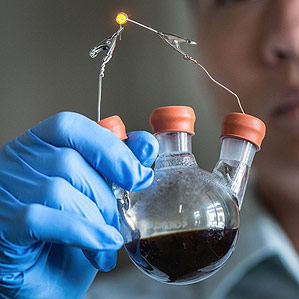
There’s a promising new entry in the race to build cheap batteries for storing energy from solar panels and wind turbines. Stanford researchers led by Yi Cui, a professor of materials science and engineering, have demonstrated a partially liquid battery made of inexpensive lithium and sulfur. Cui says the battery will be easy to make and will last for thousands of charging cycles.

Cui believes that the material and manufacturing costs of the battery might be low enough to meet the Department of Energy’s goal of $100 per kilowatt-hour of storage capacity, which the DOE estimates will make the technology economically attractive to utilities. Existing batteries can cost hundreds of dollars per kilowatt-hour of capacity, although several companies are working to commercialize cheaper ones (see “Ambri’s Better Battery” and “Battery to Take On Diesel and Natural Gas”).

The technology is a cross between a flow battery and an experimental type called a lithium-sulfur battery. In a flow battery, positive and negative liquid electrolytes are stored in swimming-pool-size tanks. The batteries are attractive because the amount of energy they store can be increased simply by expanding these tanks, without increasing the size of the electronic connections and other battery parts needed to extract the energy. But they require expensive ion membranes and large amounts of material.

For Full Article: http://www.technologyreview.com/news/514266/battery-could-provide-a-cheap-way-to-store-solar-power/

Comment by Anumakonda Jagadeesh